The Very Quiet Cricket
The Very Quiet Cricket by Eric Carle.
The Very Lonely Firefly
The Very Lonely Firefly by Eric Carle. Haven’t read this book but I’m sure you can follow the same format.
First attempt to provide a curriculum based kindergarten drawing.
Hi, everyone, it’s been a while since I posted a drawing. No excuses just haven’t done it. I have been given more motivation recently as some kindergarten teachers expressed interest in incorporating drawings into their classroom. So I decided to make it a little challenging for myself and see how I can include academics into my activities. The first drawing is The Hungry Caterpillar by Eric Carle. Remember you can go at the pace of the class so you can pause or rewind when needed. Here are some suggested directions.
Directions
- Draw the Letter D in the middle of the page. If you want you can already have the letter D on the page for students so that it would be easier for them to learn spatial awareness. I started in the middle so that the students have room to draw the fruit.
- Draw two circles in the D
- Draw circles inside those circles
- Draw a circle for the mouth or nose or whatever that is
- Draw the antennas
- Draw the letter C next to the letter D
- Continue making C’s (I think I ended up making 19)
- Draw an “L” for the legs
- Draw some fine hair
Suggested activities
- Write a sentence or two about what the caterpillar ate. Their opinion or favorite part.
- Draw that fruit (practice drawing shapes)
- Color picture
- Have them draw a certain amount of each fruit and count them or add them together.
How I incorporate academics into my sessions.
I once worked with a PT in a Massachusetts preschool that had an activity for every week of the year based on what the theme was for that month. Since her caseload changed every one or two years, she could use it over and over again. I thought this was a brilliant idea because most of the time I think of my activities on the drive to work. I decided to make a yearly activity list for my professional goal (for supervision and evaluation), needless to say, I did not achieve that goal that year. Probably because I am a procrastinator, slightly disorganized, or I just didn’t care enough. The experience did teach me one thing. For the past 10 or so years, I have been incorporating the student’s academics into my sessions whether or not it’s individual, small group, or a whole class. Not only does it provide the students with a more creative way to practice spelling or learn the weather or simple machines, it increases the communication with the teachers and your supervisor and principal will feel like you are being proactive. An added bonus is that the parents are pretty happy too. I also choose one activity and tweak it. This week, the students, in a k, 1, and 2 self-contained classroom, are learning about animal homes which included the three little pigs. All of these students have goals based on writing, cutting, copying, and attention. They completed the directive drawing activity and wrote a sentence.
I modified the same activity for a higher functioning class but had them generate their own sentences. For another class, I modified it again and had the students add a box around the pig because they were going to mail it to where ever they wanted. Then the had to measure it and figure out the area and perimeter of the box to reinforce a math lesson while still meeting my OT goals.
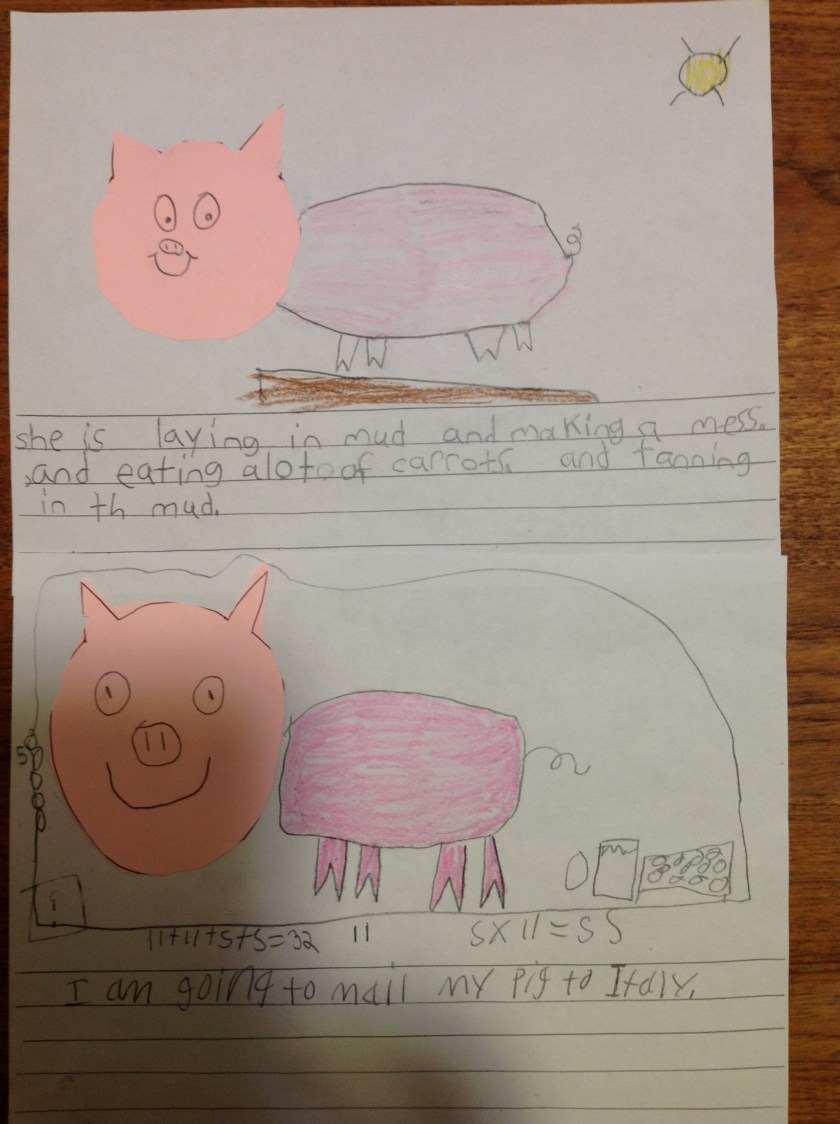 For these examples, I drew the outline of the head so that the students can practice cutting and drawing.
Celebrating Presidents Day
Here is a simple activity that addresses several skills such as cutting, drawing, writing, spatial awareness and the ability to complete a multi-step task. This activity to can be graded to a variety of skill levels. I am able to complete this task with a group of students that are not on the same level but have similar goals. Although the activity may look simple, it is engaging especially to the students with attention difficulties. All three of these students have a diagnosis of ADHD (one with autism) and none of them are medicated. I find that drawing activities help students control their impulsivity and slow them down which improves the handwriting for students who use quick strokes and chicken scratches for writing. They need to do controlled lines, know when to start and stop a line, and they learn how to self-correct (sometimes with a verbal prompts such as “does that look the same?”) Most of the time I do not tell students what we are drawing or I will do the directive drawings upside down, both the teachers and students love because they all try to guess what it is.

I often incorporate letters into the drawing as much as I can. I started this drawing out with the letter “L” as you can see in the video. I then added a “w” then another “L” and added a “c” for his ear. I always incorporate some sort of writing at the end. You can have the student write the name, copy a sentence, or generate their sentences.
This week’s drawing
I found that the students with poor fine motor skills have really low self-confidence regardless of what age. Maybe they see their peers writing, drawings, and colorings or maybe they keep hearing how poor their handwriting is. In 16 years, I can’t remember one student of mine that didn’t at least attempt to draw when guided. What I like about drawing is how subjective it is. I actually like the “imperfections.” I tell my students that drawing is just a bunch of straight and curvy lines (similar to writing). As they go through the process of a directive drawing activity, I would provide verbal prompts such as “does that look the same” or “what shape or letter does that look like”. With students, that have visual spatial difficulties, before they draw their next line I will say, “where do you think you should start? Above, below, to the right, or left?”. Same thing with size “does that circle look bigger or small than this one?” My strength as an OT is building confidence. Once the student sees the finished product, even though they may have only done a little line at a time, you can see how proud they are. Then I incorporate the writing. Maybe it’s just a title, name, copying sentences or generating sentences. Oh and it helps, when the teacher provides positive feedback also. So here is a quick drawing. If the student doesn’t know who Pikachu is, they can always just make up a story.
Grinch directive drawing activity
Drawing improves fine motor skills
 DrawOT